
By DC Engineers | Architecture, Engineering & Construction
The digital transformation of the construction industry extends far beyond the use of advanced design software.
As projects become more complex, the need for better coordination, more reliable cost control and more structured technical information is driving the wider adoption of Building Information Modeling (BIM).
BIM is increasingly changing the way architects, engineers, contractors and project managers collaborate throughout the entire lifecycle of a project.
For developers and property investors, however, the real value of BIM is not the technology itself.
It is the ability to improve coordination, predictability, quality and decision-making from design through construction and operation.
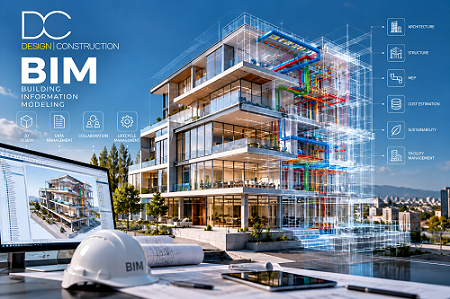
What BIM Really Means
BIM is a methodology for creating, organising and managing digital information related to a building or infrastructure project.
It combines geometric information with data concerning building elements, materials, systems, quantities and technical characteristics.
Its value goes well beyond three-dimensional modelling.
A properly structured BIM environment allows different design disciplines to work with coordinated information rather than relying on disconnected drawings and separate files.
This can significantly improve collaboration between architects, structural engineers and mechanical, electrical and plumbing consultants.
Better Coordination Between Design Disciplines
One of the most common sources of problems during construction is poor coordination between different design packages.
Mechanical services may conflict with structural elements. Ceiling zones may be insufficient for ductwork. Equipment locations may interfere with circulation or architectural requirements.
When these issues are discovered on site, they often result in delays, redesign and additional cost.
BIM allows the different design models to be reviewed together before construction begins.
Through clash detection, potential geometric conflicts can be identified at an earlier stage.
This does not eliminate the need for engineering judgement.
It simply allows technical teams to identify and resolve conflicts before they become construction problems.
BIM and Construction Cost Control
Reliable cost planning depends on accurate information and clearly defined quantities.
When BIM models are properly structured, they can support more systematic quantity take-offs and measurement processes.
As the design changes, quantities can be updated more consistently, allowing project teams to assess the cost impact of design decisions.
This can be particularly valuable during:
- design development;
- value engineering;
- tender preparation;
- procurement;
- and variation management.
However, BIM does not automatically produce a reliable construction budget.
The quality of the output depends on the quality of the model, the level of information included and the measurement rules applied.
Professional cost management remains essential.
BIM simply provides a stronger information base to support it.
Connecting BIM with the Construction Programme
BIM can also be linked to the project schedule.
This is often referred to as 4D BIM.
By connecting building elements with planned construction activities, project teams can visualise the sequence of works and identify potential logistical or coordination problems.
This can support:
- construction sequencing;
- site logistics;
- access planning;
- coordination between subcontractors;
- and programme reviews.
For complex developments, visualising how the project is intended to be constructed can make programme discussions clearer and more practical.
As with cost control, however, the technology does not replace project management.
Actual progress must still be monitored, reported and compared with the approved programme.
BIM as a Project Management Tool
The greatest value of BIM often emerges when it becomes part of the wider project management process.
A Project Manager requires reliable information regarding:
- design status;
- outstanding decisions;
- technical changes;
- coordination issues;
- procurement information;
- construction progress;
- and project documentation.
A structured digital environment can improve the way this information is controlled and distributed.
The use of a Common Data Environment (CDE) can help ensure that drawings, models, specifications and technical documents are managed through agreed processes.
This can reduce confusion over document versions and provide clearer accountability regarding approvals and revisions.
For larger developments, these information-management procedures can become as important as the models themselves.
BIM for Multi-Project Developments
BIM becomes even more valuable when a developer manages several projects at the same time.
Common standards for:
- model structure;
- naming conventions;
- technical documentation;
- reporting;
- and information exchange
can create greater consistency across a portfolio.
This allows knowledge gained on one project to be applied more effectively to others.
For developers operating multiple residential, hospitality or commercial schemes, standardisation can support better quality control and more efficient project delivery.
The objective is not to make every project identical.
It is to create a consistent management framework while allowing each development to respond to its own technical requirements.
BIM and Change Management
Changes are inevitable in most construction projects.
The problem is not the existence of change.
It is the failure to understand its impact.
A design modification can influence structure, MEP systems, quantities, cost, procurement and programme.
When project information is fragmented, these consequences may not be identified until late in the process.
BIM can support a more coordinated approach to change management by making dependencies more visible.
This allows the project team to assess the broader consequences of a proposed change before it is implemented.
For developers, this can improve decision-making and reduce the risk of unexpected downstream costs.
BIM Does Not Replace Engineering Expertise
There is sometimes a tendency to present BIM as a technological solution capable of resolving project-management problems automatically.
That is not realistic.
The quality of a BIM process depends on the people using it, the information being produced and the procedures established for collaboration.
A poorly managed BIM environment can create as much confusion as traditional fragmented documentation.
Successful implementation requires:
- clearly defined objectives;
- appropriate modelling standards;
- agreed responsibilities;
- trained project teams;
- and disciplined information management.
Technology supports the process.
It does not replace professional judgement.
From Digital Design to Integrated Project Delivery
The real potential of BIM lies in connecting design, cost, programme and technical information within a coordinated project environment.
For developers and investors, this can provide better visibility of project risk and stronger control over decision-making.
For consultants and contractors, it can improve coordination and reduce avoidable conflicts.
For Project Managers, it creates the opportunity to manage technical information in a more structured and transparent way.
At DC Engineers, we view BIM as part of a broader approach to integrated project and construction management.
The objective is not simply to produce sophisticated digital models.
It is to use better information to improve the way projects are designed, coordinated, costed and delivered.
BIM is not simply a different way of producing drawings. It is a different way of managing information and decisions throughout the lifecycle of a project.
All articles © DC Engineers — Architecture, Engineering & Construction.
Reproduction, republication or distribution of this article, in whole or in part, without prior written consent from DC Engineers is prohibited, subject to applicable legal exceptions.