
By DC Engineers | Architecture, Engineering & Construction
Purchasing land for a property development in Greece requires more than confirming ownership, location and building potential.
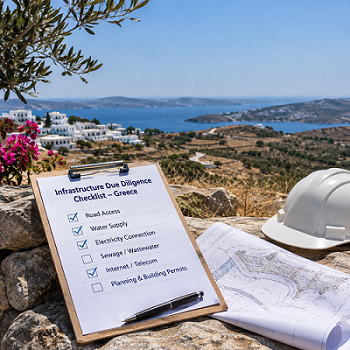
A plot may be legally buildable while still presenting substantial technical challenges relating to electricity, water supply, wastewater management, access or construction logistics. These issues can influence the development budget, construction programme and long-term operational performance of the completed property. For international investors, infrastructure due diligence should therefore form part of the initial acquisition assessment.
Buildability does not guarantee infrastructure availability
Planning and building regulations determine whether a proposed development may be permitted, subject to applicable conditions. However, planning eligibility does not automatically establish the availability or capacity of essential utility networks. An investor should distinguish between the legal ability to construct a building and the practical ability to service and operate it. This distinction is particularly important for developments in rural, coastal and island locations.
Electrical connection and available capacity
Electricity requirements should be assessed early in the feasibility process. A modern villa or hospitality development may require significant electrical capacity for heating, cooling, domestic hot water, swimming pools, EV charging and other installations. The presence of nearby electricity infrastructure does not necessarily confirm sufficient available capacity. Depending on the project, connection arrangements may require additional equipment, network extensions or reinforcement. The design team should establish preliminary load requirements and coordinate the necessary enquiries with the relevant network operator.
Water supply and seasonal demand
Water availability is a critical consideration for many Greek developments. A property may require water for domestic consumption, landscaping, swimming pools and hospitality operations. Seasonal tourism demand can place additional pressure on local water infrastructure. The feasibility study should assess the proposed source of supply, available network information, expected demand and any additional storage or treatment requirements. Where alternative supply arrangements are being considered, their technical and regulatory feasibility must be verified.
Wastewater management
Wastewater disposal arrangements should be examined before the development design is finalised. Where a suitable public sewer connection is unavailable, an alternative legally permissible solution may be required. The appropriate approach depends on site conditions, applicable regulations, anticipated wastewater volumes and the relevant authority’s requirements. Wastewater infrastructure can affect land allocation, building positioning, external works and project costs.
Road access and construction logistics
Legal and practical access should be evaluated separately. A plot may have access rights but still present challenges for construction vehicles, deliveries or heavy equipment. Steep terrain, narrow roads, restricted turning areas and difficult site geometry can affect construction methodology. For island developments, transport arrangements and material availability may also influence procurement and scheduling. These constraints should be reflected in the preliminary construction budget.
Infrastructure requirements for hospitality developments
Hotels and tourism complexes typically have more complex infrastructure requirements than individual residences. Higher occupancy, commercial kitchens, laundry facilities, pools, fire safety systems and extensive mechanical installations may significantly increase utility demand. Infrastructure planning should therefore be coordinated with the proposed operating model. A design that meets architectural objectives but overlooks operational requirements may require costly revisions at a later stage.
Assessing infrastructure-related investment risk
A structured feasibility review should identify the infrastructure already available, the additional works potentially required and the approvals still outstanding. Where information cannot be confirmed before acquisition, the uncertainty should be explicitly recorded. The investor can then consider appropriate contractual protections, contingency allowances or further investigations before committing to the transaction.
DC Engineers — Technical Due Diligence and Development Feasibility
DC Engineers supports international investors and property owners through technical due diligence, planning assessments, engineering coordination and Project Management in Greece. Our approach considers the development site as a complete technical and operational system, helping clients identify constraints before they become construction-stage problems. Early infrastructure assessment supports more reliable acquisition decisions, realistic development budgets and better-controlled project delivery.
All articles © DC Engineers — Architecture, Engineering & Construction.
Reproduction, republication or distribution of this article, in whole or in part, without prior written consent from DC Engineers is prohibited, subject to applicable legal exceptions.