
By DC Engineers | Architecture, Engineering & Construction
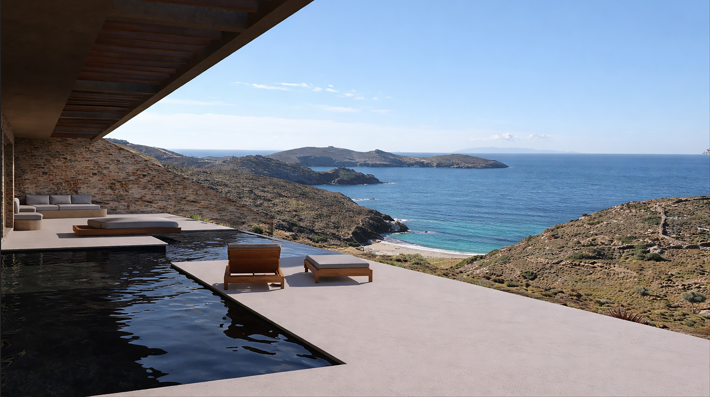
For many foreign buyers, the ambition is not simply to purchase an existing property in Greece — it is to build. To design a home from the ground up, on a plot of land with a view they have chosen, in a place that feels entirely their own.
Building on a Greek island is achievable. It is also more complex than building on the mainland, and more demanding than most buyers anticipate when they first acquire a plot. The variables — regulatory, logistical, technical, and climatic — are specific to the island context and require experienced management.
This guide sets out the full process, from plot acquisition to completed construction, with the precision that a project of this nature demands.
The Appeal and the Reality
The Greek islands offer building conditions that are genuinely exceptional: light, landscape, proximity to the sea, and an architectural vernacular that has defined Mediterranean aesthetics for centuries. They also present constraints that do not exist to the same degree on the mainland.
Material and labour costs are higher. Logistics are more complex. Planning regulations in traditional settlements are more restrictive. The construction season is frequently compressed by weather and tourism activity. And the consequences of poor workmanship are harder to rectify in a location where access to specialist contractors is limited.
None of these factors make island construction inadvisable. They make thorough preparation essential.
Step 1: Plot Selection and Technical Assessment
The acquisition of a suitable plot is the single most consequential decision in the entire process. A structurally sound building on a poorly chosen plot is still a problematic investment.
Before committing to a purchase, the following must be assessed by a qualified civil engineer and topographer:
Buildability
Not every plot sold in Greece is legally buildable. Buildability depends on:
- Surface area: Greek planning law sets minimum plot sizes for building permission to be granted. These thresholds differ between plots within settlement boundaries (εντός σχεδίου) and those outside them (εκτός σχεδίου). Island plots outside settlement boundaries typically require a minimum of 4,000 sq.m., though exceptions and local variations exist.
- Frontage: The plot must have sufficient road frontage to meet the applicable planning requirements.
- Zoning classification: Agricultural, forestry, coastal protection, and archaeological buffer zones impose restrictions that may prohibit construction entirely or limit it significantly.
- Proximity to the coastline: Greek law prohibits construction within defined setback distances from the sea. These distances vary based on coastal classification and are strictly enforced.
Topography and Ground Conditions
Island plots are frequently sloped, rocky, or both. A topographic survey will establish the accurate boundaries and elevation profile. A geotechnical assessment — particularly for plots on slopes, near cliff edges, or on fill material — establishes the bearing capacity and foundation requirements. These directly affect construction cost.
Infrastructure and Access
Confirm the availability and proximity of:
- Potable water connection or the feasibility of a borehole
- Electricity grid connection
- Sewerage or the requirement for a private treatment system
- Road access sufficient for construction vehicles — a critical and frequently underestimated issue on island plots
Step 2: Regulatory Framework — What You Can Build
Greek planning law, applied to island construction, is layered and location-specific. The following parameters govern what may be built on any given plot.
Building Coefficient
This determines the maximum total floor area permitted relative to the plot size. It varies by zone and is set by local planning authorities.
Coverage Ratio
This limits the footprint of the building as a percentage of the plot area, independently of the total permitted floor area.
Height Restrictions
Island municipalities — particularly those with declared traditional settlements — impose strict height limits, frequently tied to the surrounding built environment and the roofline of adjacent structures.
Architectural Style Requirements in Traditional Settlements
Many Greek island villages are designated traditional settlements. Construction within or adjacent to these zones is subject to architectural review. Materials, colours, roof form, window proportions, and external finishes may all be prescribed by local regulation. Deviations require specific approval and are not guaranteed.
This is not merely an aesthetic constraint. It defines the scope of the architectural design from the outset and must be understood before a designer is commissioned.
Step 3: Design — Architecture and Engineering Studies
Once plot buildability and planning parameters are confirmed, the design process begins. A complete set of studies is required for building permit submission.
Architectural Study
The architectural design must comply with all applicable planning parameters and, where relevant, with the aesthetic requirements of the local planning authority. On island sites, bioclimatic design principles — orientation, natural ventilation, shading, and thermal mass — are not merely desirable; they materially affect the building's performance and running costs in a climate of high solar gain and occasional winter exposure.
Structural Study
Greece's seismic context requires a full structural design compliant with Eurocode 8. On island sites, the structural design must also account for:
- Wind loads, which are substantially higher in exposed coastal locations
- Salt air environment, which accelerates corrosion of reinforcement and metallic elements if inadequately specified
- Foundation conditions specific to the site's geotechnical profile
Electromechanical Studies
These include electrical installation, plumbing, heating and cooling systems, solar energy provision, and — where applicable — swimming pool and elevator design. On islands with intermittent grid reliability or limited water supply, off-grid or hybrid energy and water systems warrant serious consideration and must be designed accordingly.
Energy Efficiency Study
All new buildings in Greece require an energy study and must achieve a minimum energy classification. Island buildings, if well-designed, can readily achieve A or A+ classification, which has direct value implications in the rental and resale market.
Step 4: Building Permit — Process and Timeline
The building permit is issued by the competent Urban Planning Office of the relevant municipality. The process involves submission of the complete study set, review by the planning authority, and — in traditional settlements — additional review by the relevant architectural council.
Realistic timeline: For straightforward island projects outside traditional settlements, permit issuance typically requires three to six months from complete submission. Projects within traditional settlements or requiring special approvals should be planned with a longer lead time.
The permit is issued to the property owner. All studies must be signed and sealed by licensed Greek engineers of the relevant specialties. Foreign professionals may not sign Greek building permit submissions — all design work must be executed or co-signed by Greek-licensed engineers.
Step 5: Contractor Selection and Contract Structure
On Greek islands, the selection of a qualified and reliable contractor is more consequential than on the mainland, and the pool of available contractors is smaller.
Key considerations in contractor selection:
- Demonstrated experience with island construction — site access management, material procurement logistics, and weather-contingent scheduling require specific competence
- Permanent or established island presence — a contractor who mobilises from the mainland for each work phase is operationally inefficient and difficult to supervise
- Financial stability — advance payments to an undercapitalised contractor are a documented source of project failure; verify financial standing before contracting
- References — request and follow up on references from completed projects of comparable scale
The construction contract should be detailed and should include, as a minimum:
- Full scope of works with reference to the approved studies
- Fixed or unit-rate pricing with clearly defined variation procedures
- Construction programme with milestone dates
- Payment schedule linked to verified progress, not elapsed time
- Retention provisions
- Defined process for material substitutions and approvals
- Dispute resolution mechanism
A contract that relies on verbal understandings exposes the owner to significant risk. This is particularly true for foreign owners who are not permanently present on site.
Step 6: Construction Supervision
The Greek building permit system requires a Supervising Engineer who is legally responsible for ensuring that construction proceeds in accordance with the approved permit and studies. This is a mandatory statutory role.
However, the statutory supervising engineer's obligations are defined by law and do not necessarily encompass the level of quality oversight that a demanding project warrants. For foreign owners — particularly those who are not resident in Greece during construction — independent construction supervision, conducted by an engineer retained directly by the owner, provides a materially higher level of protection.
Independent supervision covers:
- Regular site visits with written reports and photographic documentation
- Verification of material compliance with specified standards
- Review of workmanship at critical stages — foundations, structural frame, waterproofing, installations
- Progress assessment against the construction programme
- Interface with the contractor on the owner's behalf
- Flagging of issues before they become embedded in completed work
The cost of independent supervision is modest relative to total construction cost. The cost of rectifying defects in a completed island building — particularly structural or waterproofing defects — is not.
Step 7: Costs — Establishing a Realistic Budget
Island construction costs are consistently higher than equivalent mainland projects. The following factors drive this differential:
- Material transport: All materials must be shipped to the island, with freight costs, loading and unloading logistics, and transit times that vary by island and season
- Labour: Skilled tradespeople working on island projects typically command a premium; accommodation costs for mainland contractors are borne by the project
- Programme compression: The tourist season limits construction activity in some locations during peak months; weather windows constrain work in exposed sites during winter
As a general indicator, construction costs on Greek islands for a well-specified residential project typically range from €1,500 to €2,500 per square metre of built area, depending on specification level, island, and site conditions. This figure excludes land acquisition, design fees, permits, and site preparation.
These are indicative figures only. A detailed cost estimate, prepared on the basis of the approved studies and specific site conditions, is the only reliable basis for budget planning.
Step 8: Completion — Certificates and Legal Registration
On completion, the following are required to establish the building's legal standing and enable use:
- Certificate of completion issued by the supervising engineer
- Energy Performance Certificate (final, based on as-built condition)
- Building Electronic Identity — a comprehensive digital record of the building's permits, studies, and legal status, now mandatory for new constructions
- Registration of the completed building in the Ktimatologio (land registry) and update of the property's E9 tax declaration
Until these steps are completed, the building cannot be legally used, rented, or sold.
Managing the Process from Abroad
The majority of foreign clients who commission construction on Greek islands are not permanently resident in Greece during the build. This is a manageable situation, provided the right structures are in place:
- Retain an experienced project manager or supervising engineer who provides regular written reporting and is reachable between visits
- Plan a minimum of two or three site visits at critical construction milestones — foundation completion, structural frame completion, and pre-finishing stage
- Ensure all material and design approvals are documented in writing before work proceeds
- Establish clear communication protocols and response time expectations with your contractor and engineer from the outset
Distance does not preclude successful island construction projects. Inadequate supervision does.
Summary
Building on a Greek island is a substantial undertaking that rewards careful preparation. The regulatory framework is navigable, the construction industry has the competence to deliver high-quality results, and the end product — a well-designed, properly built home in one of Europe's most distinctive landscapes — represents enduring value.
The critical variables are plot selection, regulatory compliance, contractor quality, and the rigour of supervision. Each of these is manageable with qualified, independent professional guidance.
DC Engineers — Project Management and Construction Supervision for International Clients
DC Engineers holds offices in both Athens and Andros, Cyclades, providing direct, permanent presence in both the mainland and island contexts. We undertake the full range of services required for island construction projects: feasibility assessment, architectural and engineering design, building permit processing, contractor selection support, and independent construction supervision — conducted and communicated in English throughout.
We work with international clients at every stage of the process, from initial plot assessment through to building completion and legal registration.
This article is provided for informational purposes and does not constitute legal or financial advice. Readers are advised to seek qualified professional counsel specific to their project and circumstances.