
By DC Engineers | Architecture, Engineering & Construction
Athens continues to attract property buyers seeking residential accommodation, rental investments and redevelopment opportunities.
However, the relationship between property prices, construction costs and achievable investment returns is becoming increasingly important.
In October 2026, market data highlighted a significant difference between the budgets of many prospective buyers and the asking prices of available residential properties.
While demand is concentrated in the €200,000–250,000 range, a substantial part of the available housing stock is advertised at higher prices.
For investors, this creates an important question:
Can purchasing and renovating an older property provide a financially viable alternative to acquiring a newly built apartment?
The answer depends on the technical condition, planning status and total development cost of the property.
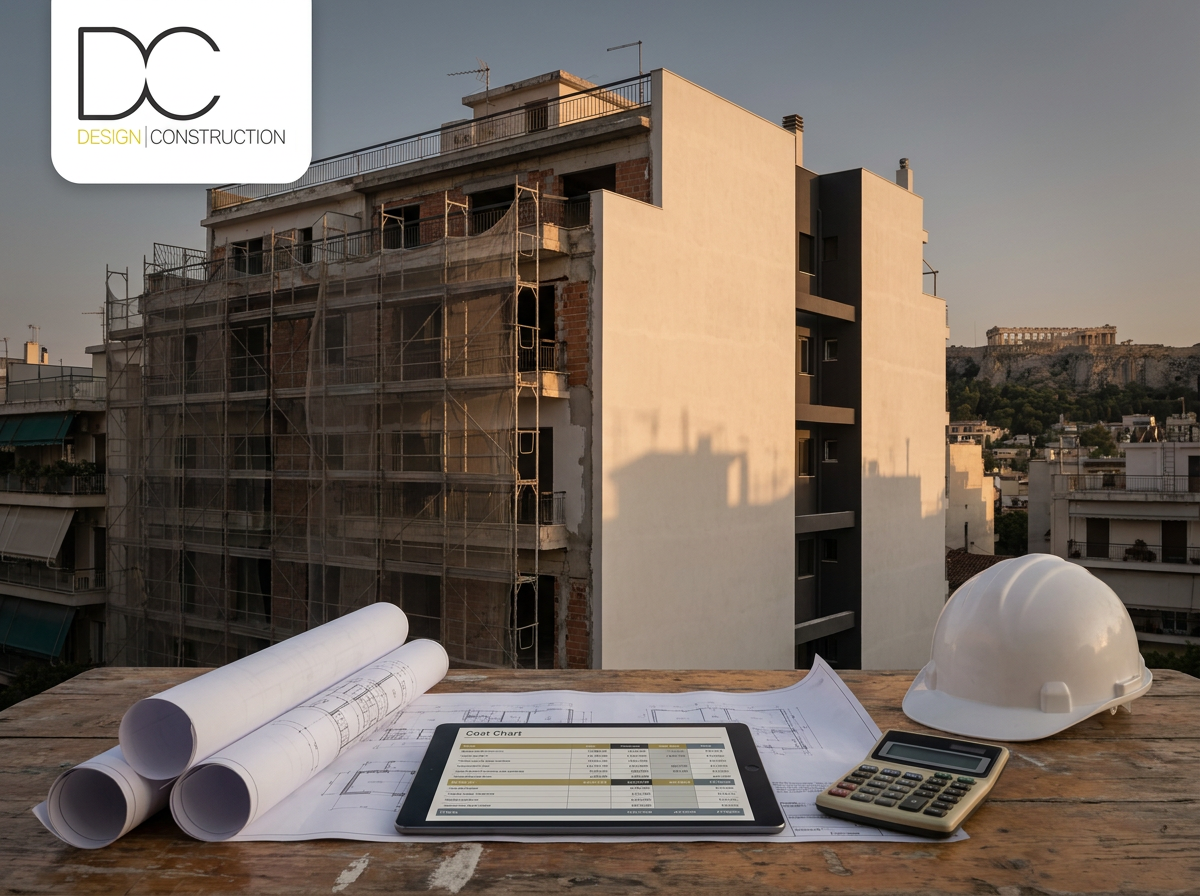
Purchase Price Is Only the Starting Point
An attractive asking price does not necessarily indicate a profitable investment.
Older apartments may require substantial renovation, including the replacement of electrical installations, plumbing systems, windows and heating equipment.
Structural defects or unauthorised alterations may introduce additional costs.
The financial assessment should therefore include the complete acquisition and renovation budget.
This means evaluating the purchase price together with transaction expenses, professional fees, permits, construction works and contingency allowances.
A realistic investment appraisal should also consider the time required to complete the renovation and bring the property into use.
Technical Due Diligence Before Acquisition
Technical due diligence is particularly important when purchasing older properties in Greece.
The assessment should establish whether the existing building complies with its approved planning documentation.
This involves reviewing the original building permit, approved drawings and any subsequent modifications.
The inspection should also examine the visible condition of the structural elements, building envelope and mechanical and electrical installations.
Where discrepancies are identified, their implications for legal compliance and future renovation must be assessed.
Some issues can be resolved through the appropriate procedures, while others may restrict the intended development strategy.
Identifying these constraints before acquisition can prevent significant financial exposure.
Renovation Feasibility and Architectural Design
The architectural potential of an existing apartment depends on its layout, structural configuration and building services.
A property with an inefficient internal arrangement may offer opportunities for functional improvement.
However, removing internal partitions or relocating kitchens and bathrooms may require additional technical investigation.
The design process should evaluate natural lighting, ventilation, circulation and the practical requirements of the intended occupants.
For rental investments, the layout should be appropriate for the target market.
For resale projects, the objective is to create a property that meets market expectations without introducing unnecessary construction expenditure.
Building Permits and Planning Compliance
Renovation works in Greece are subject to different administrative procedures depending on their scope.
Some interventions may require a building permit or small-scale works approval.
Other limited works may fall under different regulatory provisions.
The appropriate procedure must be determined by a qualified engineer after reviewing the property and the proposed works.
Structural modifications, changes of use and interventions affecting common building areas require particular attention.
The renovation programme should allow sufficient time for the necessary approvals before construction begins.
Understanding the Complete Renovation Budget
A reliable renovation budget should be based on a defined technical scope.
This includes identifying the required works, material specifications, quantities and construction methods.
The budget should distinguish between essential repairs, functional improvements and optional upgrades.
A contingency allowance is also important, particularly where hidden defects may become apparent after demolition or removal of existing finishes.
Consider an illustrative investment:
| Cost Component | Amount |
|---|---|
| Property purchase | €220,000 |
| Renovation works | €35,000 |
| Professional fees and permits | €7,000 |
| Construction contingency | €7,000 |
| Subtotal | €269,000 |
This hypothetical example excludes acquisition taxes, notarial and legal expenses, financing costs and other transaction-specific charges.
It demonstrates how a property initially priced within a buyer's budget may require substantially more capital before it becomes ready for occupation or rental.
Energy Performance and Operating Costs
Energy efficiency is an increasingly important factor in residential property investment.
Older buildings may have inadequate insulation, outdated windows or inefficient heating and cooling systems.
These characteristics can increase operating costs and reduce indoor comfort.
A renovation provides an opportunity to improve building performance through coordinated technical interventions.
However, energy upgrades should be selected according to the building's actual characteristics and the expected economic benefit.
The most expensive solution is not necessarily the most appropriate.
An integrated design approach can help balance construction expenditure, energy performance and long-term maintenance requirements.
Evaluating Rental and Resale Potential
The investment strategy should be established before finalising the renovation design.
A property intended for long-term rental may require different finishes, equipment and maintenance considerations from a property intended for resale.
Expected rental income should be evaluated against realistic operating expenses, taxation, management costs and potential vacancy periods.
For resale projects, the expected selling price should be supported by comparable transactions rather than asking prices alone.
The investment appraisal should also consider the possibility that market conditions may change during the renovation period.
Construction Management for International Investors
International investors often manage Greek property projects without being permanently based in the country.
This creates additional requirements for coordination, reporting and construction supervision.
A structured project management approach should include a defined scope of work, procurement strategy, construction programme and cost-control procedures.
Regular reporting allows the investor to monitor progress and make informed decisions.
Independent technical oversight can also help identify construction issues before they become costly defects.
Making an Informed Property Investment Decision
Purchasing and renovating an older property in Athens can offer attractive opportunities when the project is technically feasible and financially justified.
However, the investment should not be assessed solely on the difference between the purchase price and the expected resale value.
Planning compliance, renovation costs, construction risks and market positioning all influence the final outcome.
At DC Engineers, we support international property buyers and investors through technical due diligence, architectural and engineering design, permitting, renovation budgeting and construction management.
Our objective is to help investors understand the complete technical and financial implications of a property before committing substantial capital.
All articles © DC Engineers — Architecture, Engineering & Construction.
Reproduction, republication or distribution of this article, in whole or in part, without prior written consent from DC Engineers is prohibited, subject to applicable legal exceptions.