
By DC Engineers | Architecture, Engineering & Construction
For decades, hostels occupied a relatively small corner of the hospitality market: low-cost accommodation, independently operated properties and a customer base dominated by young budget travellers.
That model is changing rapidly.
Across Europe, larger investors are increasingly treating modern hostels and hybrid accommodation concepts as a scalable real estate investment product. At the same time, obsolete offices, ageing hotels and other underperforming commercial buildings are being repositioned into hospitality assets rather than demolished and redeveloped from the ground up.
The significance of this trend extends well beyond the hostel sector.
It reflects a broader change in European real estate: investors are increasingly looking for value not simply by acquiring better buildings, but by finding better uses for existing ones.
For developers, property owners and investors, this places adaptive reuse, technical due diligence and conversion feasibility firmly at the centre of the investment process.
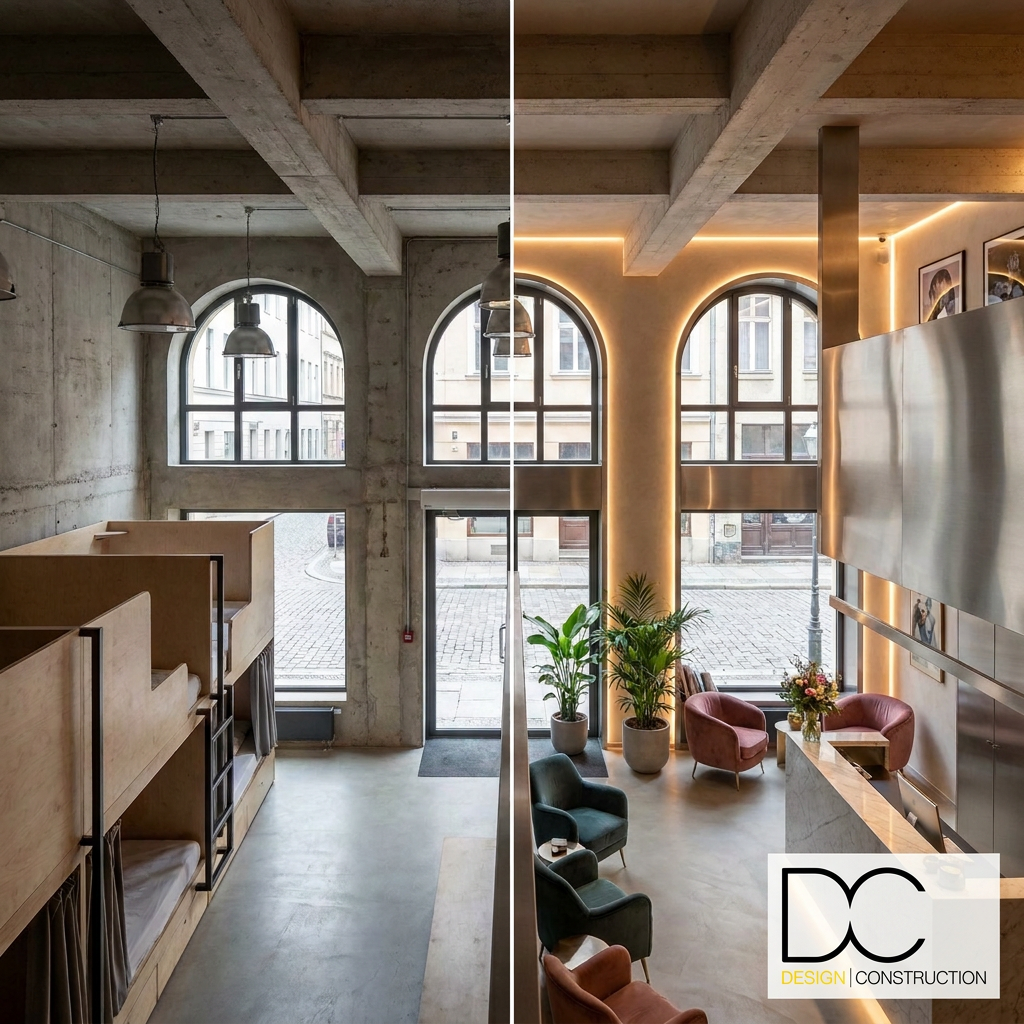
The Hostel Product Has Changed
The traditional image of a hostel no longer accurately represents much of the modern European market.
New-generation concepts combine private rooms, shared accommodation, family rooms, food and beverage, co-working areas, social spaces and design-led interiors within a single operating platform.
The result sits somewhere between a budget hotel, a lifestyle hotel and traditional shared accommodation.
This broader product mix has expanded the customer base considerably.
Young travellers remain important, but modern hostel concepts can also attract families, couples, groups, business travellers and guests seeking centrally located accommodation at a lower price point than conventional hotels.
From an investment perspective, that diversification matters.
It creates a product with broader demand, more flexible room configurations and potentially higher revenue density than the traditional hostel model.
Why Institutional Capital Is Paying Attention
Institutional investors typically look for several characteristics in a real estate sector:
-
scalability,
-
repeatable operating models,
-
sufficient market depth,
-
predictable demand,
-
opportunities for portfolio growth,
-
and an identifiable exit market.
The European hostel sector increasingly demonstrates many of these characteristics.
Large operators can apply common branding, centralised booking platforms, technology, procurement and operating procedures across multiple countries.
This transforms individual properties into part of a wider operating platform.
For investors, the attraction is therefore not simply the acquisition of one accommodation asset.
It is the possibility of creating or expanding a portfolio that can operate consistently across multiple European cities.
This is one of the fundamental characteristics required for a niche property sector to evolve into an institutional asset class.
The Real Opportunity May Be in Existing Buildings
Perhaps the most interesting element of this investment trend is not the hospitality product itself.
It is the property strategy behind it.
Rather than relying entirely on new construction, many operators are expanding by acquiring existing buildings and converting them.
Former offices are particularly important.
Hybrid working, changing corporate space requirements and tightening energy-performance standards have created a growing divide between modern prime offices and older secondary stock.
Some buildings can economically be upgraded and remain offices.
Others cannot.
For these properties, changing use may offer a more compelling investment case than attempting to compete with new Grade A office stock.
Hospitality is becoming one of the potential destinations for this capital.
Why Hostels Can Work Particularly Well in Conversion Projects
From a design perspective, hostel and hybrid accommodation formats can offer greater flexibility than certain conventional hotel products.
A traditional hotel brand may impose strict room dimensions, layouts and operating standards.
A hybrid hostel concept can potentially accommodate a wider mix of:
-
private rooms,
-
twin rooms,
-
family rooms,
-
four-bed rooms,
-
larger shared rooms,
-
and flexible common areas.
That flexibility can make it easier to respond to an existing structural grid, window arrangement and building geometry.
Instead of designing the building around a single repetitive room module, the operator may be able to design the accommodation mix around the building.
This does not make conversion simple.
But it can make previously difficult floorplates commercially usable.
Adaptive Reuse Is Not Just an Architectural Exercise
The visual transformation of an obsolete office into an attractive hospitality property is often the most visible part of a conversion.
It is rarely the most difficult.
Before an investor commits capital, the building must be assessed as an engineering asset.
Key questions include:
Can the existing structure support the proposed use?
New loads, plant equipment, additional bathrooms, partitions, rooftop uses and alterations to circulation can affect the structural strategy.
Can the required number of rooms actually be achieved?
Existing column grids, cores, façades, window positions and escape routes may significantly limit the theoretical accommodation capacity.
Can the mechanical and electrical systems be adapted economically?
Hospitality buildings require substantially different ventilation, hot-water, cooling, electrical and fire-safety infrastructure from many offices.
Can the building achieve the required fire strategy and means of escape?
Changes of use can substantially alter fire compartmentation, evacuation requirements and life-safety systems.
Can accessibility requirements be satisfied?
Existing entrances, lifts, circulation routes and floor levels may require significant intervention.
These issues can transform an apparently attractive acquisition into a highly complex redevelopment.
Conversion Feasibility Must Come Before Acquisition
A low acquisition price is not enough to make an adaptive-reuse project viable.
The correct investment equation is:
**Acquisition cost
-
conversion CAPEX
-
professional and permitting costs
-
financing
-
programme risk
-
operating ramp-up
= total development basis.**
This total must then be evaluated against the achievable operating performance and stabilised asset value.
That is why technical due diligence for a conversion opportunity should go beyond identifying defects.
It should establish whether the building can support the proposed business model.
A technically sound but inefficient floorplate may destroy the commercial case.
Conversely, an ageing building with significant refurbishment requirements may still offer excellent investment potential if the structure, location and configuration allow efficient conversion.
Programme Can Be as Important as Cost
Adaptive reuse is often promoted as faster than new construction.
It can be — but only when the existing building is understood properly.
Unexpected structural works, undocumented alterations, hazardous materials, insufficient electrical capacity, fire-safety upgrades or permitting complications can create substantial delays.
For hospitality assets, programme delays have particular financial consequences.
Missing the beginning of a major tourism season may mean losing several months of revenue rather than simply delaying rent commencement by a few weeks.
A realistic development programme should therefore be prepared at the same stage as the preliminary CAPEX assessment.
The Sustainability Case Is Becoming Stronger
Adaptive reuse also aligns with the changing environmental framework affecting European buildings.
Demolishing an existing structure and constructing a replacement requires substantial quantities of new materials and generates significant waste.
Where an existing structural frame can be retained and successfully adapted, the project may preserve a large amount of embodied carbon already invested in the building.
As European regulation increasingly moves toward whole-life building performance rather than operational energy alone, this can become an increasingly relevant part of the investment case.
The most sustainable building is not automatically the newest one.
In some cases, it may be the building that can be successfully given another life.
Athens Offers an Interesting Testing Ground
The same forces reshaping European cities are increasingly visible in Athens.
The city contains a considerable stock of older commercial buildings, including offices developed during previous economic cycles that no longer necessarily satisfy modern occupier requirements.
At the same time, Athens has become a stronger year-round tourism and city-break destination and continues to attract international hospitality capital.
This creates a potentially interesting intersection:
obsolete commercial stock + central locations + tourism demand + increasing international investment.
Several office-to-hospitality conversions have already demonstrated that the model can work in the city.
However, this does not mean every vacant office is a future hotel or hostel.
Location, planning status, building geometry, structural condition, fire strategy, natural lighting, accessibility and conversion CAPEX all need to align.
The Next Opportunity May Be a Building That Has Lost Its Original Use
Real estate investment has traditionally focused heavily on location and asset class.
Adaptive reuse introduces a third variable:
alternative use.
A property that no longer performs well as an office may still be a strong hospitality asset.
An ageing hotel may support a completely different accommodation concept after repositioning.
An underused commercial building may have considerably greater value after technical and operational restructuring.
Finding that value requires investors to assess property not only according to what it is today, but according to what it can realistically become.
Engineering Due Diligence Is Part of the Investment Strategy
Adaptive reuse succeeds when the investment thesis, operational concept and technical characteristics of the building are evaluated together.
Before acquiring a property for conversion, investors should establish:
-
whether the proposed use is permissible;
-
whether the existing building can technically accommodate it;
-
what structural and MEP interventions will be required;
-
what realistic room or unit capacity can be achieved;
-
what the conversion is likely to cost;
-
how long design, permitting and construction may take;
-
and whether the resulting asset supports the intended investment return.
These are not questions to answer after acquisition.
They are part of determining whether the acquisition should happen at all.
At DC Engineers, we support investors and property owners through pre-acquisition technical due diligence, conversion feasibility, CAPEX assessment, planning and permitting coordination, design management and construction monitoring.
As European real estate continues to evolve, some of the most interesting opportunities may not come from constructing new buildings.
They may come from recognising the hidden value in buildings that already exist — and engineering their next use.
All articles © DC Engineers — Architecture, Engineering & Construction.
Reproduction without permission is not permitted.