
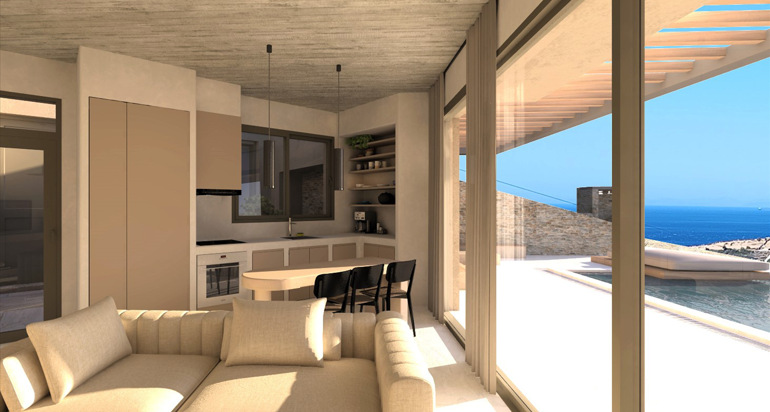
By DC Engineers | Architecture, Engineering & Construction
Remote renovation management has become an established mode of working for international property owners in Greece. Technology has made communication easier, and the Greek construction industry has considerable experience with foreign clients who are not permanently present during works. What technology has not changed is the fundamental nature of construction: it is a physical process, conducted by people, with variables that cannot be fully managed from a distance without the right structures in place.
This article addresses the full scope of what remote renovation management requires — the process, the risks, the contractual framework, and the professional roles that make the difference between a project that delivers and one that does not.
Why Renovation Projects Fail
Before addressing the process, it is worth being direct about why renovation projects in Greece — and particularly those managed remotely — encounter problems.
The most common causes are:
Inadequate scope definition at the outset. A renovation brief that relies on verbal understandings, approximate descriptions, or the contractor's interpretation of intent is a brief that will generate disputes. The scope of works must be defined in writing, in sufficient technical detail that there is no ambiguity about what is and is not included.
Unrealistic budgeting. Renovation costs in Greece are consistently underestimated by foreign buyers, often on the basis of informal quotations obtained before a full technical assessment has been conducted. Hidden defects, regulatory requirements, and the true cost of quality materials and skilled labour are not captured in a preliminary estimate.
Payment structures that favour the contractor. Advance payments disproportionate to completed work reduce the owner's leverage and the contractor's incentive to perform. This is the single most reliable predictor of project problems.
Absence of independent supervision. A contractor who is both executing and self-reporting on the quality of their work is operating without accountability. The interests of contractor and owner are not aligned in a construction contract, and the supervision structure must reflect that reality.
Regulatory non-compliance. Works undertaken without the required authorisations create arbitrary construction status, with legal consequences that persist and compound. This is particularly common in remote renovations where the owner is not present to ask the right questions.
Understanding these failure modes is the first step to avoiding them.
Step 1: Technical Assessment Before Design
Before any design work begins and before any contractor is approached, a thorough technical assessment of the existing property is required. This is non-negotiable for a remote renovation, because it is the foundation on which every subsequent decision — scope, budget, programme, contractor selection — is based.
The assessment should establish:
- Structural condition: Integrity of the load-bearing system, evidence of cracking, settlement, or deterioration, and any structural interventions required to meet current seismic standards
- Condition of building fabric: Roof, external walls, waterproofing, windows and external doors
- Mechanical and electrical installations: Age, condition, and compliance of electrical installation, plumbing, heating and cooling systems
- Presence of hazardous materials: Asbestos-containing materials are present in a significant proportion of Greek buildings constructed before 1990, particularly in roof tiles, floor adhesives, and pipe insulation. Their identification and safe removal must be addressed before works begin
- Arbitrary construction status: Cross-referencing the physical property against the approved building permit, to identify any elements that require regularisation before the renovation permit can be processed
- Planning constraints: Any restrictions applicable to the property by virtue of its location, listing status, or zone classification that will affect the scope of permissible works
This assessment must be conducted in person, by a qualified engineer, and must result in a written report. A video call walkthrough with the owner is a useful complement but is not a substitute.
Step 2: Scope Definition and Design
With the technical assessment complete, the renovation scope can be defined with precision. This is the document that drives everything that follows — the permit application, the contractor tender, the contract, and the supervision programme.
The scope document should define:
- Works to be carried out, by trade and location
- Materials and finishes specifications, with brand and product references where relevant
- Works explicitly excluded from the scope
- Interface with any elements to be retained
Vague descriptions such as "full renovation of bathroom" or "repair roof as necessary" are not acceptable in a scope document intended to form the basis of a contract. Each item must be sufficiently specified that two contractors pricing the same document will arrive at comparable figures.
Where the renovation is substantial, a full architectural and engineering design is required — both to define the scope with precision and to satisfy the permit requirements. For lighter-touch renovations, a detailed specification may suffice, but the line between what requires a permit and what does not must be confirmed by a licensed engineer before the scope is finalised.
Step 3: Regulatory Compliance — Permits and Authorisations
As a general principle, any renovation that alters the structure, envelope, use, or installed systems of a building requires prior authorisation. The specific category of authorisation — full building permit, small-scale works approval, or notification — depends on the nature and extent of the works.
For remote renovation clients, the following points are of particular relevance:
Do not allow works to commence before the required authorisation is in place. The pressure to begin quickly, particularly when the owner is remote and the contractor is eager to mobilise, is a common context in which this rule is broken. The consequences — arbitrary construction status, stop-work orders, fines — are the owner's liability, not the contractor's.
Regularise before you renovate. If the pre-purchase technical assessment identified arbitrary constructions, these must be formally declared and regularised before the renovation permit is submitted. Attempting to obtain a renovation permit on a property with unresolved arbitrary constructions will result in rejection.
Verify the contractor's stated permit status. Contractors sometimes represent that certain works do not require authorisation in order to avoid the delay and cost of the permit process. This representation should always be confirmed independently by your engineer.
Step 4: Contractor Selection
For remote renovations, contractor selection carries greater weight than for projects where the owner is present daily. The relationship is necessarily one of greater delegation, and the contractor's character, competence, and financial stability matter as much as their price.
A structured selection process should include:
Tendering on a defined scope. Issue the scope document to a minimum of three contractors and require itemised pricing. Comparative analysis of itemised tenders reveals far more than comparison of lump sum figures — it shows where contractors are making assumptions, where they are cutting corners, and where their understanding of the scope diverges from yours.
Reference verification. Request references from at least two completed projects of comparable nature and scale, and follow up directly with the clients. Ask specifically about programme adherence, responsiveness, and how problems were handled.
Site visit with shortlisted contractors. Do not appoint a contractor who has not physically inspected the property. A contractor pricing from drawings and descriptions alone will price with contingencies that inflate the cost, or with omissions that generate claims during execution.
Financial verification. A contractor who requires a large advance payment to mobilise is signalling a cash flow dependency that creates project risk. Verify that the contractor has the financial capacity to carry reasonable work-in-progress before payment milestones are reached.
Step 5: The Contract
The renovation contract is the primary risk management instrument for the remote owner. It must be written, detailed, and signed by both parties before any works commence or any payment is made.
Essential contract provisions include:
Scope of works — by reference to the agreed scope document and approved plans. Any work outside this scope requires a written variation order, signed by both parties, before it is executed.
Contract price and payment schedule — payments linked to verified milestones, not to elapsed time or the contractor's cash flow requirements. A typical structure for a renovation project might be: 20% on commencement, 30% on completion of structural and rough-in works (verified by inspection), 30% on completion of finishes, and 20% on final handover and snagging sign-off.
Programme — a construction programme with defined milestone dates. Include provisions for delay, distinguishing between delays caused by the contractor, delays caused by factors outside the contractor's control, and delays caused by the owner.
Materials approval — a process for the contractor to submit material and product proposals for owner approval before procurement. This is essential for remote owners who cannot visit a showroom.
Reporting obligations — define the frequency, format, and content of progress reports. Weekly written reports with photographs, at a minimum, are reasonable for an active renovation project.
Dispute resolution — define how disputes will be resolved. For contracts with foreign owners, this clause warrants specific legal advice.
Step 6: Independent Supervision
For a remote renovation, independent supervision is not a luxury — it is the mechanism by which the owner maintains informed oversight of a process they cannot directly observe.
The supervising engineer's role encompasses:
Regular site visits — the frequency should be calibrated to the phase and intensity of works. During structural and rough-in phases, weekly visits are appropriate. During fitting-out, fortnightly may suffice. Each visit results in a written report with photographic documentation, shared with the owner.
Quality verification at critical stages — foundations and structural frame before pouring, waterproofing before covering, electrical and plumbing rough-in before plastering. These are the stages at which defects, if present, must be identified — because once covered, they are expensive to access and rectify.
Programme monitoring — assessment of actual progress against the agreed programme, with early identification of delays and their causes.
Variation management — review and approval of any proposed variations to scope or specification before they are executed. Remote owners are particularly vulnerable to scope creep and unnecessary variations; an independent engineer provides a technical filter.
Payment certification — verification that the works claimed for payment under each milestone have been satisfactorily completed before authorising disbursement. This is perhaps the most financially valuable function of independent supervision.
Snagging — a systematic inspection of all completed works prior to final payment and handover, resulting in a written defects list that the contractor must address before the retention is released.
Step 7: Common Scenarios and How to Handle Them
"We've found additional works that weren't in the original scope." This is the most frequent statement in renovation projects, and it ranges from legitimate to opportunistic. Your engineer should assess whether the additional works are genuinely necessary, whether they were reasonably discoverable during the pre-renovation assessment, and what the fair cost should be. No additional works should be executed without a written variation order.
"Materials you specified aren't available — we've substituted something equivalent." Substitutions should never proceed without prior written approval. "Equivalent" is a judgement that belongs to the owner and their engineer, not the contractor. Establish this in the contract and enforce it consistently.
"We're behind programme because of weather / supply delays / other trades." Distinguish legitimate delay from contractor-caused delay. Legitimate delay may justify programme extension; it does not justify additional payment unless the contract provides for it. Contractor-caused delay should be addressed promptly, in writing, with reference to the contract terms.
"We need an advance payment to order materials." If this is not provided for in the contract payment schedule, treat it with caution. Legitimate material procurement is better handled through direct supplier payment for major items, or through a modest advance against a specific itemised material list, with delivery to site confirmed before the next payment is released.
Summary
Remote renovation of a Greek property is entirely achievable and, for well-prepared owners, a rewarding process. The properties available for renovation in Greece — across the mainland, the islands, and Athens itself — represent significant opportunity, both for personal use and as investment assets.
The conditions for success are consistent: thorough pre-renovation assessment, precise scope definition, regulatory compliance from the outset, a well-structured contract, and independent supervision throughout. None of these conditions is difficult to establish. Each of them, if absent, materially increases the probability of a problematic outcome.
DC Engineers — Remote Renovation Management for International Property Owners
DC Engineers provides the full range of services required for successful remote renovation management in Greece: pre-renovation technical assessment, scope definition and design, permit processing, contractor selection support, independent construction supervision, and project management — with all client communication conducted in English.
Our offices in Athens and Andros give us direct operational presence across both mainland and island renovation projects.
This article is provided for informational purposes only. Construction regulations and contractualnorms are subject to change; professional advice specific to your project and circumstances is recommended.