
By DC Engineers | Architecture, Engineering & Construction
European building regulation is moving beyond the traditional focus on operational energy efficiency.
The revised Energy Performance of Buildings Directive introduces life-cycle Global Warming Potential as a formal building performance metric, bringing embodied emissions into the regulatory framework alongside operational energy.
This represents a significant change in the way new buildings will increasingly be designed, assessed and specified across Europe.
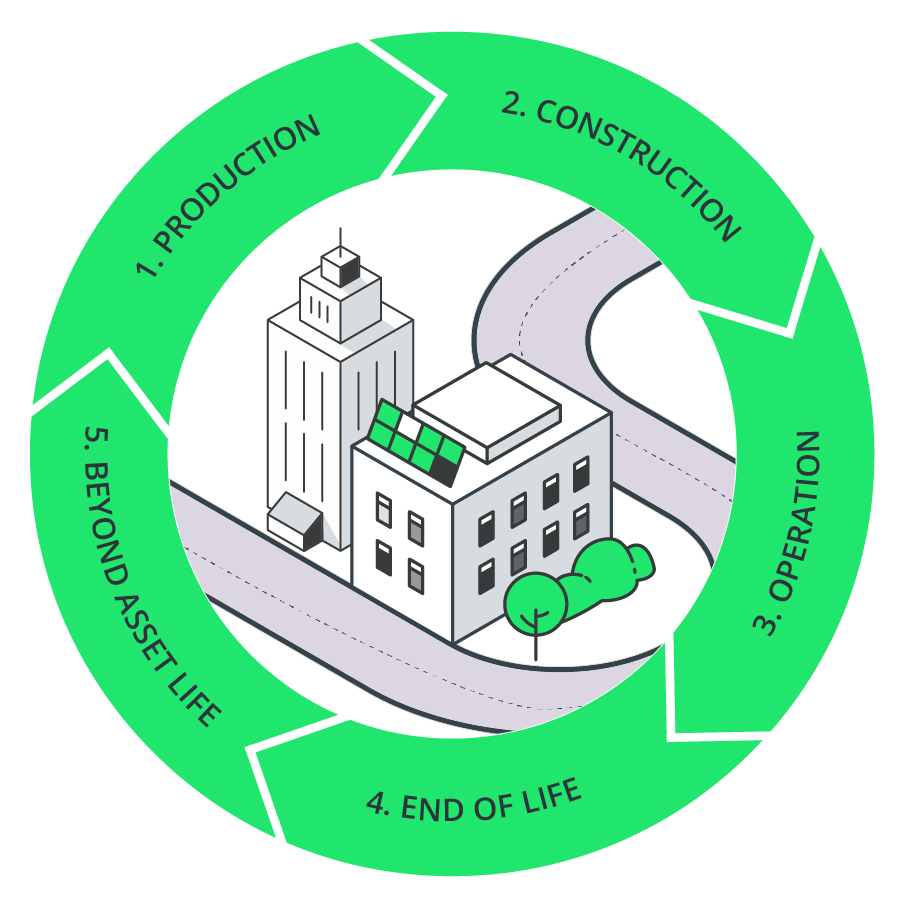
From operational energy to life-cycle performance
Energy efficiency has historically focused on the performance of the building envelope, heating and cooling systems, renewable energy integration and operational consumption.
Whole-life carbon expands this assessment to include greenhouse-gas emissions generated throughout the building lifecycle, including:
- manufacture of construction products,
- material transport,
- construction activities,
- operational energy,
- repair and replacement,
- maintenance,
- demolition,
- waste treatment,
- reuse and recycling.
The European Commission defines life-cycle GWP as the combined impact of operational and embodied emissions over the full building lifecycle.
The regulatory timetable is already established
Under Directive (EU) 2024/1275, life-cycle GWP must be calculated and disclosed in the Energy Performance Certificate:
- from 1 January 2028 for new buildings with useful floor area exceeding 1,000 m²,
- from 1 January 2030 for all new buildings.
Member States must also publish national roadmaps for the introduction of life-cycle GWP limit values and targets.
A common European calculation framework has now been established through Delegated Regulation (EU) 2026/52, intended to provide greater methodological consistency across Member States.
The framework refers to the life-cycle assessment principles of EN 15978.
Structural design will have a greater influence on carbon performance
This regulatory shift has direct implications for structural engineering.
The structural system commonly represents a significant proportion of a building's embodied carbon. Early design decisions therefore affect carbon performance before detailed material specifications are developed.
Relevant parameters include:
- structural grid,
- spans,
- slab systems,
- foundation strategy,
- concrete volumes,
- reinforcement quantities,
- steel tonnage,
- material strength classes,
- durability requirements,
- construction methodology.
This creates a stronger link between structural optimisation, cost optimisation and carbon optimisation.
The lowest-carbon solution will not necessarily be the solution with the minimum initial quantity of material. Service life, durability, adaptability and future reuse also affect whole-life performance.
Material specification will become increasingly important
The introduction of life-cycle GWP assessment will increase demand for reliable environmental data at product level.
Environmental Product Declarations, embodied-carbon factors and comparable material datasets will become increasingly relevant during specification and procurement.
For developers and design teams, this means that decisions traditionally driven primarily by cost, programme and structural performance will increasingly include a fourth parameter: measurable carbon impact.
Typical comparisons may include:
- alternative concrete mixes,
- cement substitution,
- recycled steel content,
- structural timber,
- hybrid structural systems,
- lower-carbon insulation and façade systems,
- local versus imported materials.
Carbon assessment should begin at concept stage
The greatest opportunity to influence embodied carbon generally occurs during early design, when major decisions remain flexible.
Once geometry, structural system and material strategy have been fixed, the capacity for meaningful optimisation decreases substantially.
For this reason, whole-life carbon assessment should progressively become integrated into:
- feasibility studies,
- concept design,
- structural option studies,
- material selection,
- value engineering,
- procurement strategy.
This is likely to alter the sequence of design decision-making in larger developments, particularly those that will fall within the 2028 and 2030 regulatory thresholds.
Whole-life carbon will become part of mainstream engineering practice
The shift is not merely environmental. It has regulatory, commercial and design implications.
As calculation and disclosure requirements become mandatory, developers will require design teams capable of integrating carbon performance into normal project delivery.
Structural engineers, architects, MEP designers and sustainability consultants will increasingly need to work from a common life-cycle framework rather than treating carbon assessment as a separate specialist exercise.
For engineering practices, this represents an evolution of conventional optimisation rather than a completely separate discipline: performance, cost, durability and carbon will increasingly need to be assessed together.
All articles © DC Engineers — Architecture, Engineering & Construction.
Reproduction without permission is not permitted.